Turning everyday roommate chores into a playful experience.
App Design
User Research
Prototyping
Inspired by the familiarity of a roommate chore whiteboard, Room to Bloom brings household chores/organization into a playful digital space where every completed chore helps a virtual houseplant flourish.

CONTEXT
Chores shouldn't come between roommates.


Living with roommates means sharing a space, but sharing the workload can be difficult and awkward to bring up between friends.
Between classes and extracurriculars, household responsibilities can easily become an afterthought for everyone.
This leads to:
Unequal responsibilities
Forgotten tasks
Awkward conversations
So, I found an opportunity to rethink chore management by making these responsibilities feel less like an obligation or something hard to bring up, and more like a collaborative habit.
APPROACH
Competitive Analysis
I explored existing productivity and household-management apps to understand how they approach task organization as well as motivation.
I asked friends and looked on advice forums such as Reddit to find what most people are using already.

Looking at these four competitors, I could identify where there were opportunities for a simpler and more playful chore management experience that can be designed specifically at ease for college roommates.
Three Opportunities Identified
A key differentiator is that these apps focus more on productivity specifically, while Room to Bloom would aim to combine chore management with a playful and collaborative motivation. My app would steer away from competitive scoring and move towards the concept of encouraging roommates to work toward a shared goal: nurturing a virtual houseplant through completing everyday chores.


User Research
To better understand the challenges of shared living, I developed a couple interview questions exploring how college students divide chores, communicate expectations, and manage unfinished responsibilities.
I aimed to focus on these key questions:
Understanding Current Habits
How do you and your roommates currently decide who does which chores?
Do you have a system for keeping track of chores, or is it more spontaneous?
Identifying Pain Points
Have you ever felt that household responsibilities weren't divided fairly? What happened?
How do you typically approach a roommate when they haven't completed their chores?
Exploring Motivation
What usually motivates you to complete a chore?
What would make keeping up with chores feel less like a burden?
Chores are often completed reactively rather than proactively.
SOLUTION
Visual Design
I wanted to focus on keeping my design simple and casual. I chose a font that vaguely resembles hand writing chores on a shared apartment. For colors, I used soft greens and warm neutrals to create an approachable experience that feels more like a cozy living space rather than a traditional polished productivity tool.


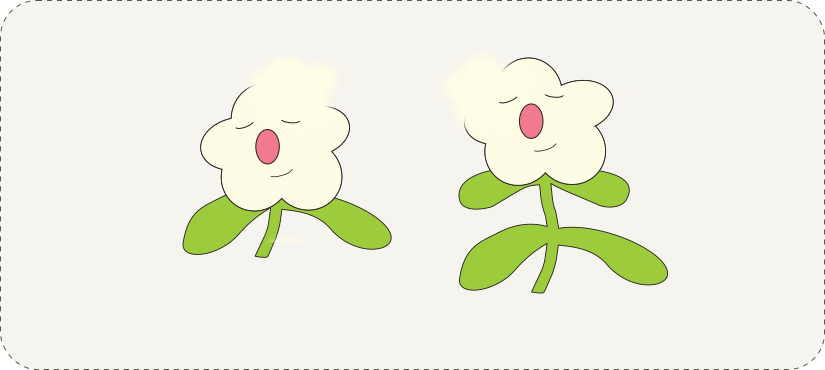
I also created some simple and approachable character designs through Adobe Illustrator.


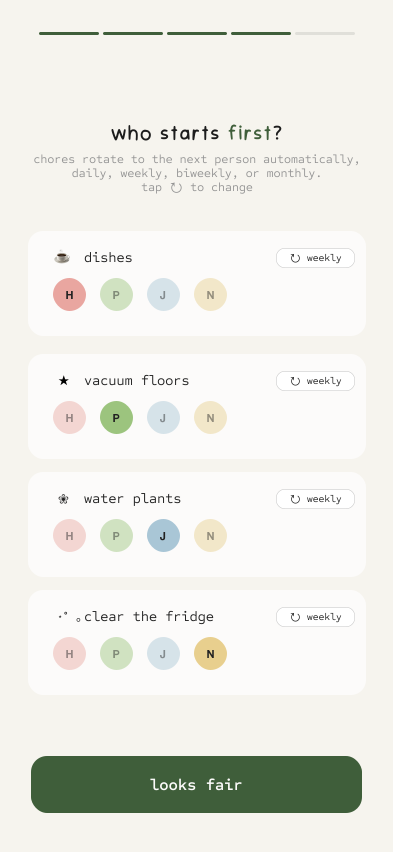
Finally, I combined everything into Figma, with the help of FigmaMake and Adobe After Effects, to create an app interface for Room to Bloom.


TAKEAWAYS
Possible Next Steps
Room to Bloom explores how playful interactions and shared progress can make everyday responsibilities more enjoyable.
Although I would say I got to bring my idea of a functional task management app to life, I could take the following next steps to gain a deeper understanding of how to achieve my motivation.
Next Steps:
Explore how the virtual plant's growth can motivate participants without creating pressure
Refine the whiteboard inspired visual system and make more interactive animations
Test whether automatic chore rotation feels fair and flexible across different roommate schedules.
What I learned
From this personal project, I got to learn how to combine my different skills such as Adobe Creative Cloud, Figma, AI collaboration, UX research to transform an initial concept into an interactive app experience.
One of my biggest takeaways was understanding the importance of intentional, unbiased UX research. I learned how the wording of interview questions can influence responses and how to approach user research with curiosity rather than assumptions. Conducting competitive analysis also pushed me to explore unfamiliar apps, evaluate their strengths and weaknesses, and identify opportunities to make my own product stand out.
On the visual design side, I experimented with different themes, typography, illustrations, and animations to develop a cohesive identity that reflected my original vision. This process challenged me to think beyond aesthetics and consider how each design decision contributes to the overall user experience.
Most importantly, this project taught me how to connect research, creativity, and technology into one cohesive product. It strengthened my ability to work across different design tools, explore ideas through iteration, and make thoughtful decisions that balance functionality with playful, engaging interactions.